Why EPT?
The “Achilles’ heel” of the ballast water treatment industry has always been the fine mesh filter. In high-turbidity waters—such as the Yangtze, Mississippi, or Amazon rivers—traditional filters (20μm–40μm) can clog instantly, forcing cargo operations to grind to a halt.
Enhanced Physical Technology (EPT) is BSKY’s answer to this global challenge. Developed through rigorous R&D and backed by YAF Diesel’s maritime engineering expertise, EPT replaces fragile mechanical filtration with a robust, three-stage physical process that keeps your vessel compliant without sacrificing operational speed.
The Three Pillars of EPT
EPT is built around a physical, filter-free workflow designed for continuous operation in real-world waters.
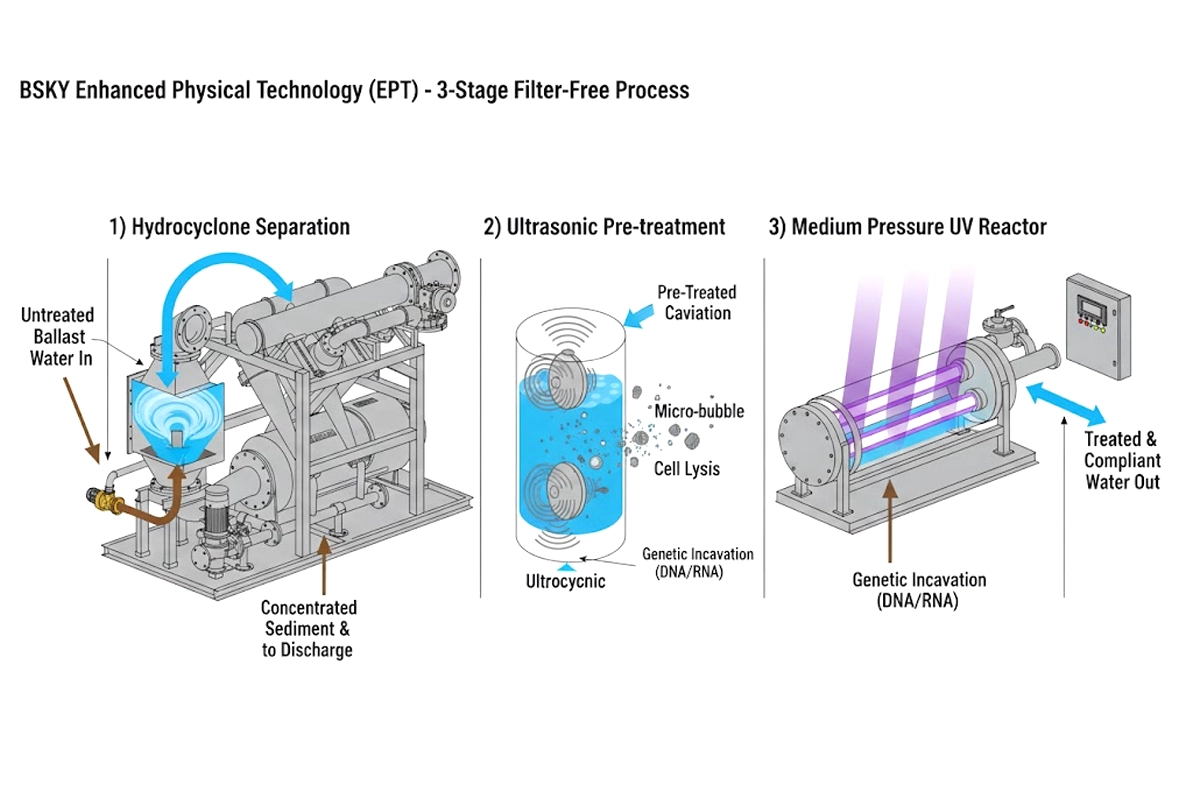
1) Hydrocyclone Separation (Physical Removal)
Instead of a mesh screen, EPT utilizes high-velocity centrifugal force.
- The Process: Water enters the hydrocyclone at a tangent, creating a powerful vortex. Dense particles (sand, mud, heavy organisms) are forced to the outer walls and discharged, while clean water is drawn into the center.
- The Advantage: Zero moving parts. Zero mesh to clean. Zero risk of “blinding” in muddy harbor waters.
2) Ultrasonic Pre-treatment (Biological Shield)
Before the water reaches disinfection, it passes through a high-frequency ultrasonic chamber.
- Synergy: Ultrasonic cavitation creates micro-bubbles that implode, shattering cell walls of larger organisms and “stunning” bacteria.
- Efficiency: Makes organisms 1.45× more susceptible to UV radiation—supporting reliable kill performance even in poor water quality.
- Automatic Cleaning: Continuous ultrasonic action helps scrub UV quartz sleeves, reducing scale buildup and bio-fouling.
3) Medium Pressure UV Reactor (Genetic Inactivation)
The final stage uses high-intensity, broad-spectrum medium pressure UV lamps.
- Total Inactivation: MP-UV targets DNA/RNA mechanisms to prevent regrowth potential after treatment.
- Compact Design: High power density reduces footprint—ideal for complex retrofits managed by YAF Diesel.
Technical Comparison: EPT vs. Traditional Filters
When operations depend on continuous ballast flow, filter-free architecture becomes a decisive advantage.
| Feature | Traditional Filter + UV | BSKY EPT Technology |
|---|---|---|
| Clogging Risk | High (in silt-heavy waters) | Non-existent (filter-free) |
| Pressure Drop | Increases as filter soils | Constant & low |
| Maintenance | Frequent cleaning / back-flushing | Minimal (Self-cleaning support) |
| Operational Uptime | Often interrupted for cleaning | Continuous flow |
| Consumables | Filter elements & seals | Long-life UV lamps |
Engineered by BSKY
Technology is only as good as its integration. YAF Diesel ensures the EPT system is seamlessly woven into your vessel’s existing architecture. From 3D laser scanning to class approval, we make sure the Filter-Free Revolution works for your specific hull and route.
Retrofit-Ready Engineering
Compact layout, clear piping logic, practical access for long-term serviceability.
Class & Documentation
Project documentation and approvals aligned with vessel constraints and yard schedules.
Frequently Asked Questions (FAQ)
Does the absence of a filter affect USCG or IMO compliance?
Not at all. BSKY EPT is fully Type Approved by both the USCG and IMO (New G8). It meets and exceeds biological discharge standards without the need for a physical mesh.
Can the Hydrocyclone handle heavy silt found in river ports?
Yes. The Hydrocyclone is specifically designed for high Total Suspended Solids (TSS). While filters get blocked by mud, the Hydrocyclone simply spins it out and discharges it.
How long do the Ultrasonic transducers last?
Our ultrasonic components are industrial-grade and designed for the life of the BWMS. They require no routine maintenance and significantly extend the life of your UV lamps by keeping them clean.
What is the footprint of an EPT system compared to a filtered system?
Because we eliminate the bulky back-flushing filter unit and use compact Medium Pressure UV reactors, the EPT system generally has a 20–30% smaller footprint, making it the ideal choice for retrofits.
Stop fighting your filters. Start ballasting with confidence.
Get technical specifications or consult an engineer to evaluate your vessel route and retrofit constraints.