Beyond Filtration
In BWMS operations, the mesh filter is the most frequent point of failure. Whether it is a 20µm or 40µm screen, traditional filters are defeated by high levels of mud, silt, and clay in the world’s most active trading ports.
BSKY’s Hydrocyclone Separation replaces fragile physical barriers with fluid dynamics. By using high-speed rotation, heavy particles and large organisms are separated from the water stream without a single millimeter of mesh to clog.
No Mesh. No Blind Spots.
Designed for high turbidity ballasting where filters fail first.
Constant Flow, Constant Schedule
Stable pressure drop supports predictable ballasting rates.
How It Works: The Physics of Clean Water
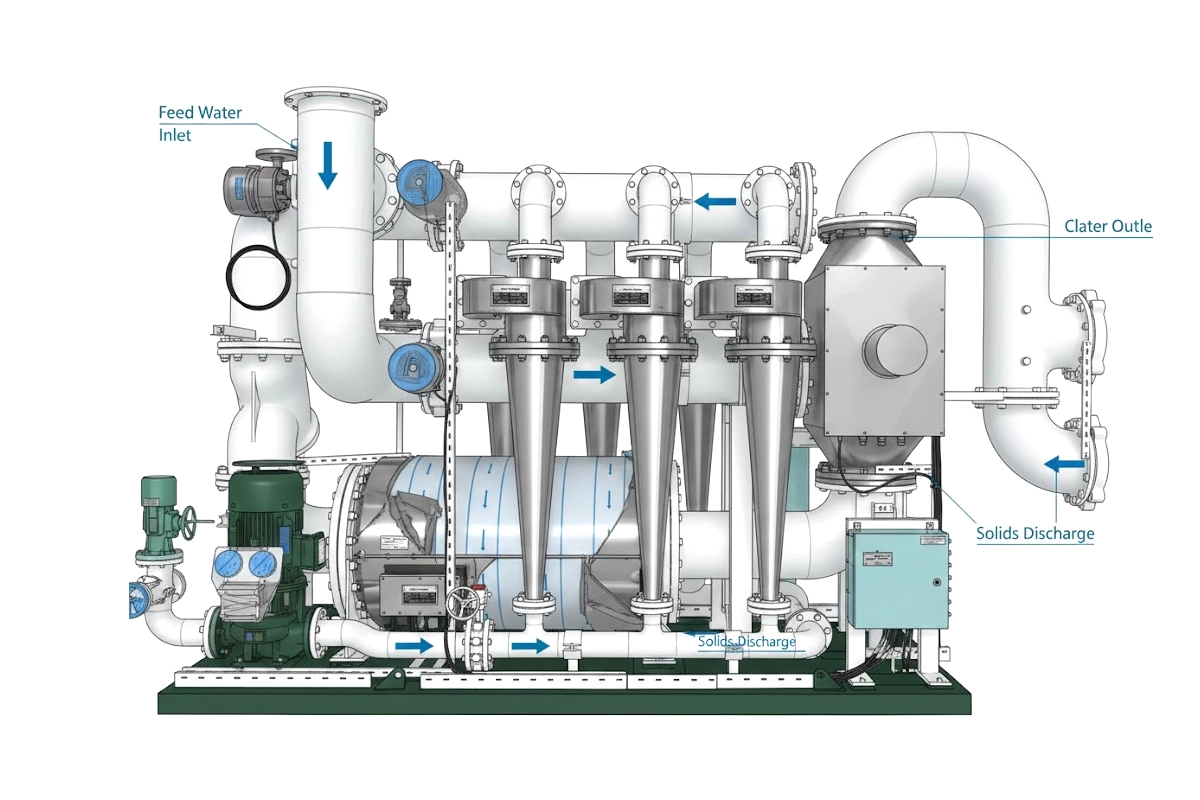
The BSKY Hydrocyclone operates on Differential Density Separation — using centrifugal forces to move heavy contaminants outward, while cleaner water flows through the core.
- High-Velocity Entry: Ballast water is pumped into the conical chamber at a precise tangent, creating a high-speed downward vortex (a “liquid cyclone”).
- Centrifugal Acceleration: As water spins, heavier particles (sand, silt, mud) and larger organisms are forced to the outer walls of the cone.
- The Underflow (Separation): Heavy contaminants slide down the walls and are continuously discharged back to the point of intake via the underflow line.
- The Overflow (Pure Flow): Lighter water reverses direction in the center and moves upward through the overflow, heading toward Ultrasonic and UV stages.
Tip: If autoplay is blocked on some browsers, the video will still render as a poster image until user interaction.
Key Advantages for Shipowners
1) Zero Clogging in Muddy Waters
Traditional filters require back-flushing when they clog — wasting time and energy. A Hydrocyclone has no mesh to blind; it performs efficiently in silty river ports as well as open ocean conditions.
2) Low Pressure Drop, High Efficiency
A clogged filter creates a major pressure drop, forcing ballast pumps to work harder and slowing ballasting rates. The BSKY Hydrocyclone maintains a constant, low pressure drop to keep cargo operations on schedule.
3) Maintenance-Free Design
With no moving parts and no filter elements to replace, the Hydrocyclone is a “fit and forget” component. No more mid-voyage filter cleanings or expensive spare mesh inventories.
4) Small Footprint, Big Performance
Our hydrocyclones are vertically oriented and compact — easier to integrate into tight engine rooms during retrofits compared to bulky horizontal filter housings.
Technical Data: Performance Metrics
| Parameter | BSKY Hydrocyclone Specification |
|---|---|
| Separation Efficiency | Removes >95% of particles >50µm (Density >1.2 g/cm³) |
| Operating Pressure | Optimized for standard ballast pump heads |
| Material | High-grade, corrosion-resistant stainless steel / Duplex |
| Moving Parts | 0 (Zero) |
| Back-flushing Requirement | None |
Engineering Insight: The YAF Diesel Edge
Not all hydrocyclones are created equal. BSKY’s geometry is optimized through Computational Fluid Dynamics (CFD) to maximize separation while minimizing energy loss.
As your engineering partner, YAF Diesel calculates the exact flow requirements for your vessel to ensure the Hydrocyclone is perfectly sized for your pump capacity — preventing cavitation and maximizing longevity.
Frequently Asked Questions (FAQ)
Does the Hydrocyclone remove 100% of organisms?
The Hydrocyclone is a pre-treatment stage. It removes the heavy bulk of sediment and large organisms. Remaining microscopic organisms are then treated by the Ultrasonic stage and finally neutralized by the UV Reactor. This 3-stage synergy is what supports IMO/USCG compliance.
What happens if we encounter extremely heavy mud?
Unlike a filter that could stop the flow entirely, the Hydrocyclone continues to spin and discharge mud via the underflow while maintaining continuous flow to the next stages. Your ballasting does not need to stop.
Is there any wear and tear inside the Hydrocyclone?
Internal wear is minimized by using high-grade, erosion-resistant materials. There are no screens to tear and no seals to leak under pressure.
Stop fighting your filters. Start ballasting with confidence.
Request drawings, footprint data, and flow sizing support for your route and pump capacity.