
The Vital Signs of Your BWMS
Pressure is the primary indicator of a Ballast Water Management System’s health. In a filter-free system like BSKY, pressure sensors do more than monitor for leaks — they provide the data needed to ensure the Hydrocyclone is operating at its peak separation efficiency.
YAF Diesel provides genuine BSKY Pressure Sensors (Transmitters) engineered for harsh, corrosive seawater systems. These sensors deliver real-time feedback to the PLC to manage flow rates and protect UV reactors from over-pressurization.
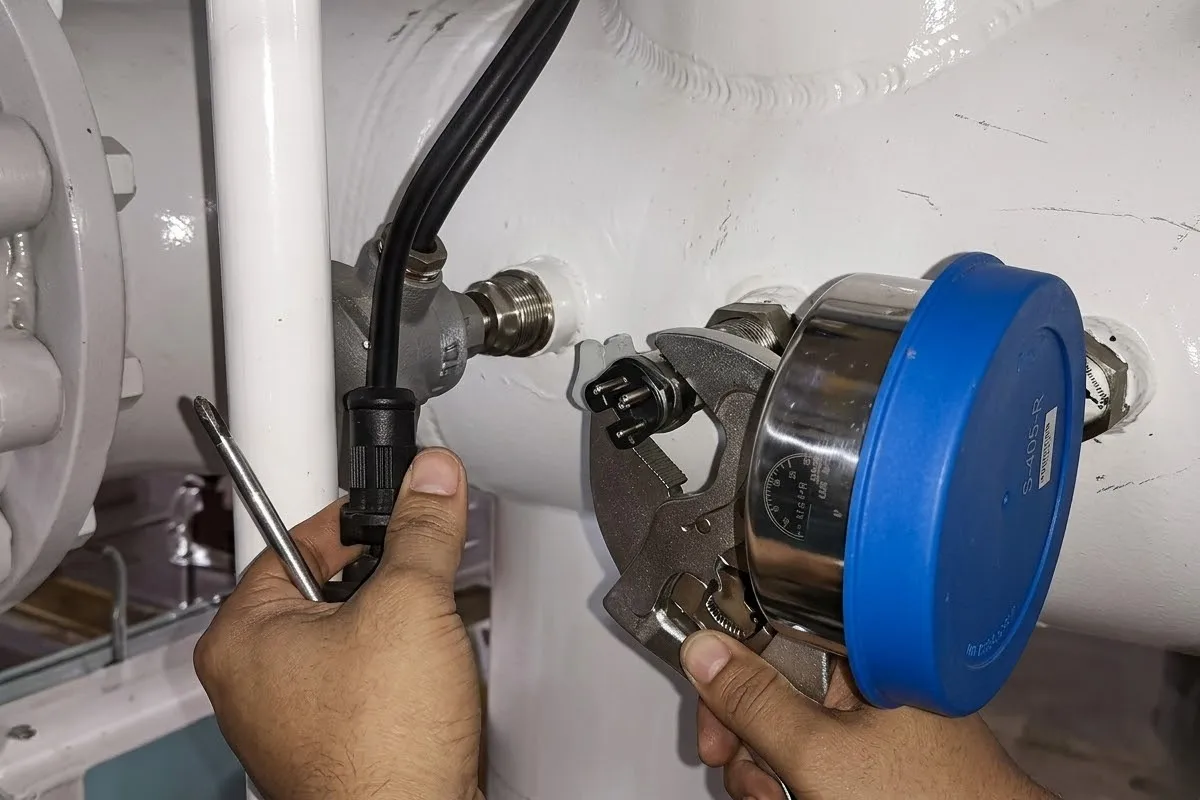
Critical Roles of the Pressure Sensor
1) Hydrocyclone Efficiency Monitoring
The Hydrocyclone relies on a specific pressure differential (ΔP) to create the centrifugal vortex that separates sediment. High-precision sensors monitor inlet and outlet pressure so the PLC can confirm separation performance is stable.
2) System Protection & Safety
If a valve is incorrectly closed or a pump malfunctions, pressure can spike. BSKY pressure sensors act as a safety “trip”: when pressure exceeds safe limits, the system triggers an alarm or a controlled shutdown to prevent equipment damage.
3) Pump Control Integration
Pressure feedback supports ballast pump control logic to keep operation within rated flow capacity — reducing cavitation risk and unnecessary energy consumption.
Typical Integration (At a Glance)
BSKY pressure transmitters are selected for stable measurements and reliable PLC inputs in noisy engine-room environments. Exact ranges and process connections are supplied per vessel/system configuration.
| Use Case | What It Protects / Confirms |
|---|---|
| Hydrocyclone Inlet/Outlet | ΔP stability for separation efficiency |
| UV Reactor Line | Over-pressure protection and safe-mode triggers |
| Pump Control Feedback | Flow stability, cavitation prevention, energy control |
Stable Separation
Pressure signals help keep the hydrocyclone vortex in its optimal operating window.
Protected Equipment
Fast alarms and safe shutdown reduce risk to UV reactors and piping.
Frequently Asked Questions (FAQ)
What is the most common reason for unexpected pressure alarms?
Often it is a valve position issue, air in the line, or pump behavior (rapid speed changes). Sensor drift or connector problems can also cause false spikes. Share trend logs and alarm codes with our team for a quick diagnosis.
Do I need to replace sensors in pairs to maintain ΔP accuracy?
Not always. If only one transmitter is proven faulty, single replacement is possible. However, for critical ΔP monitoring points, replacing as a matched pair can improve measurement consistency.
Can the crew replace a pressure transmitter onboard?
Yes, if safe isolation procedures are followed (depressurize, isolate, and confirm no trapped pressure). After replacement, verify scaling and signal integrity in the PLC. We can guide your ETO remotely via email.
Protect your system with genuine pressure monitoring.
For pressure sensor inquiries, compatibility checks, or electrical support: Email: electric@yafdiesel.com.tr